
Cologne, October 27, 2026
A new report by the Aktionsbündnis Menschenrechte-Philippinen (AMP/ German Action Network Human Rights Philippines) emphasizes that the Philippine government failed to take up effective measures and demonstrate a genuine political will to hold perpetrators of human rights violations accountable or prevent further abuses.
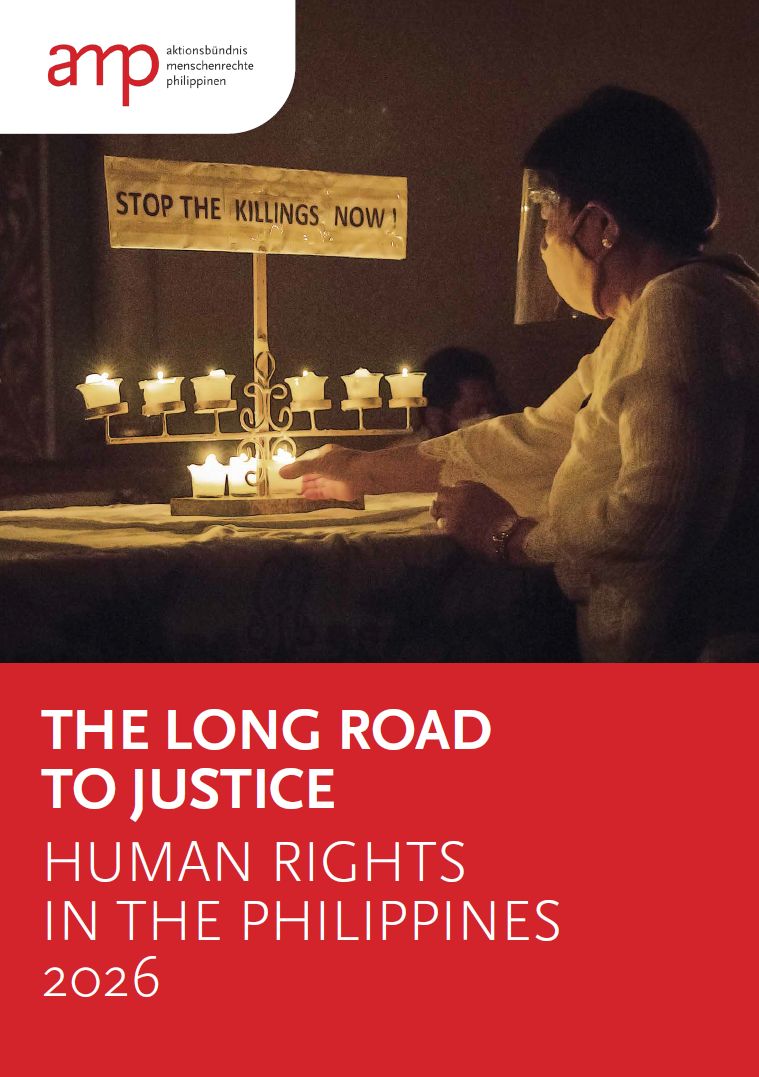
The 28-pages report, titled “The Long Road to Justice – Human Rights in the Philippines 2026”, shows that the government of President Ferdinand Marcos Jr. has made no significant progress in improving the human rights situation. On the contrary, impunity and the political persecution of human rights defenders (HRDs) remain widespread.
Drug-related killings and police violence continue to take place. The domestic criminal prosecution of the estimated 27,000 extrajudicial killings linked to the so-called “war on drugs” launched by former President Rodrigo Duterte in 2016 remains grossly inadequate, with only five known convictions secured to date.
HRDs continue to face persecution under President Marcos Jr., including through charges of terrorism financing. Alongside limited forensic capacity, a persistent lack of cooperation by the police and military with the Philippine Commission on Human Rights, victims’ families, and supporting human rights organizations remains a major driver of impunity.
Necessary legislative and institutional reform, such as the adoption of a Human Rights Defenders Protection Act and a legislation criminalizing the practice of so-called “red-tagging,” are still lacking. “Red-tagging” means accusing individuals or organizations of supporting or being members of the rebel group, the New People’s Army.
“Human rights in the Philippines are protected by the Constitution and international law, but significant challenges remain, particularly regarding extrajudicial killings, freedom of expression, and the treatment of activists. This is shown by the 2026 AMP report on the development of human rights in the Philippines,” says Jochen Range from Amnesty International Germany.
Global geopolitical tensions and the international race to secure raw materials for a “green transition” turned the Philippines into a key player in the Indo-Pacific region. Nearly two-thirds of the Philippines’ mineral reserves are located in the territories of Indigenous Peoples. Mining projects frequently cause irreversible damage to the environment and local communities.
Increased international demand for critical minerals such as nickel could lead to an expansion of mining activities. This could, among other things, worsen labor conditions and exacerbate land-related conflicts in the mining sector. A possible conclusion of an EU-Philippines free trade agreement this year could further increase pressure on natural resources if robust human rights and environmental safeguards are not effectively enforced.
“We understand the EU’s need to diversify its supply chains in order to secure its access to critical raw materials. But this must not happen at the cost of local communities in the Philippines. The adverse impacts of mining projects are very well documented. Without ensuring the effective protection of the rights of local communities and ecosystems, the EU free trade deal will exacerbate the current human rights situation,” stresses AMP project coordinator Astrud Lea Beringer.
Contact: info@amp.ngo
Download (PDF): AMP 2026 Report: The Long Road to Justice – Human Rights in the Philippines