
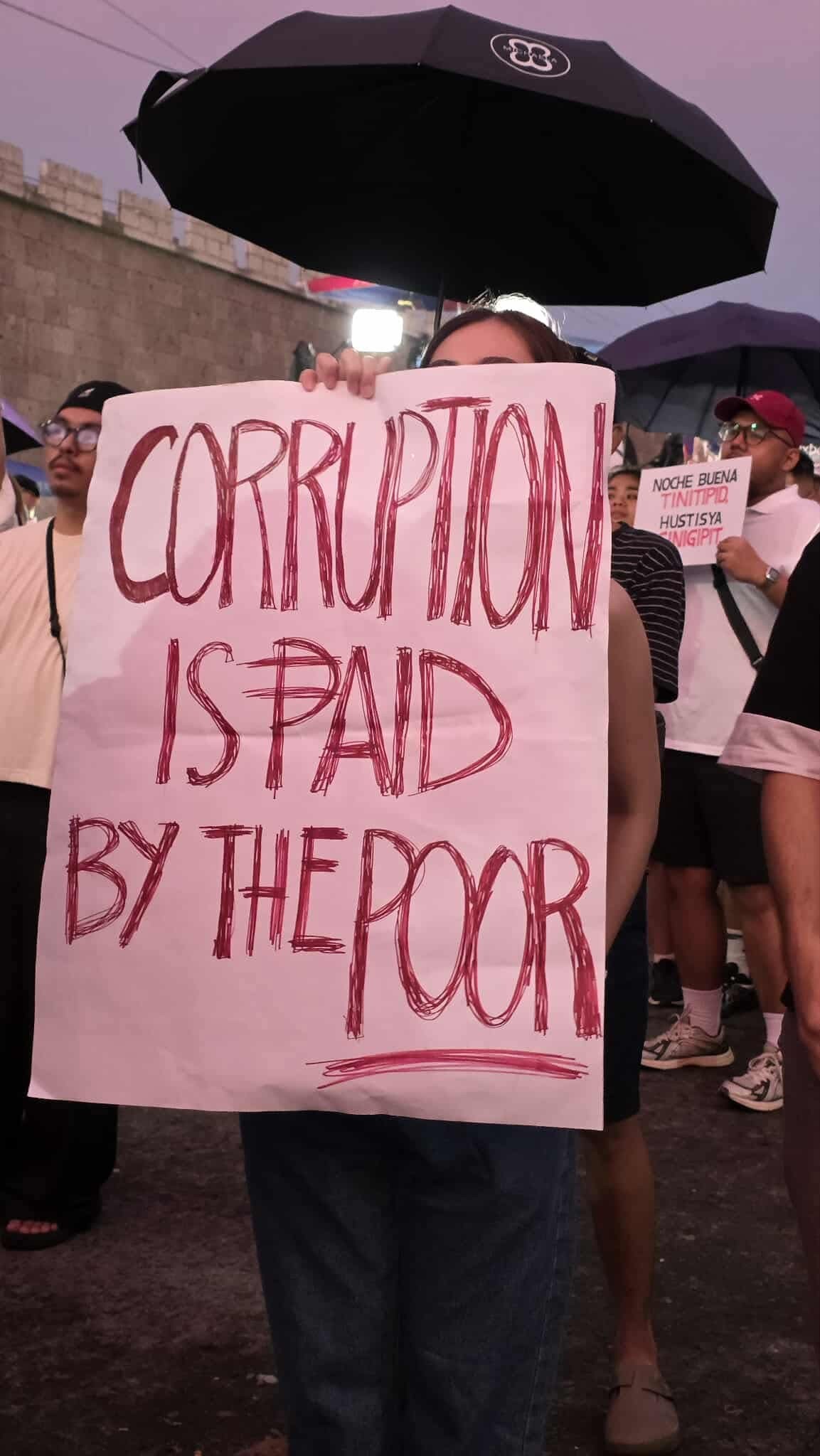
Thousands took to the streets across the Philippines on November 30, 2025, to protest against corruption. Following a similar protest on September 21, the demonstrations focused on alleged irregularities in flood-control projects involving high-ranking lawmakers, contractors, and officials from the Department of Public Works and Highways.
Protesters at the “Trillion Peso March” at the EDSA People Power Monument in Quezon City sought to hold both Ferdinand Marcos Jr. and Vice President Sara Duterte, as well as their allies, accountable for systemic injustice. Participants of “Baha sa Luneta 2.0” protest at Luneta Park in Manila called for the resignation of both Marcos and Duterte. All protesters demanded jail time and restitution from lawmakers, officials, and construction executives accused of stealing government funds.
The November 2025 protests were largely peaceful. The Philippine National Police (PNP) estimated that around 90,000 people joined demonstrations nationwide, including 16,000 in Metro Manila. Authorities deployed more than 17,000 police officers to maintain order, while the Armed Forces of the Philippines (AFP) reaffirmed their commitment to democratic stability, rejecting calls for any unconstitutional action.
Despite the calm protests in November 2025, concerns persisted over police conduct during the rallies on September 21, 2025, which erupted into violence in some parts of Metro Manila. Authorities arrested 216 people, including 91 minors, many of whom now face criminal charges. Reports indicate that young activists were subjected to mistreatment, including beatings and prolonged detention, with some abuses potentially amounting to torture.
Amnesty International has called on the Philippine government to investigate the alleged unlawful use of force by police and all reports of torture or other ill-treatment. “Filipinos participating in peaceful protests have the right to demonstrate against corruption without fear,” said Jerrie Abella, Amnesty International Philippines’ Regional Campaigner. “Police should focus on protecting citizens’ safety rather than using violence against them,” he added.
Cardinal Pablo Virgilio David addressed demonstrators at the “Trillion Peso March” in Quezon City, urging peaceful advocacy and rejecting calls for a transitional government, revolutionary rule, or the resignation of President Marcos Jr. and Vice President Duterte. “We are disciples of democracy. We are calling for real change, but in a peaceful way,” he said.
Cardinal David’s speech, while applauded by the crowd, also drew criticism and sparked debate among anti-corruption activists who raised concerns about potential divisions ahead of the 2028 presidential election.
In a related development, the Pasig City Prosecutor’s Office recently dismissed illegal assembly charges against environmental activist Jonila Castro, who had been accused of leading a protest on September 4, 2025, without a permit. The prosecutor ruled there was insufficient evidence to establish her as the organizer, noting that the law regulates public assemblies but does not prohibit them. Castro and her lawyer argued that the charges were an attempt to silence her activism.
Photo © Emmalyn Liwag Kotte